
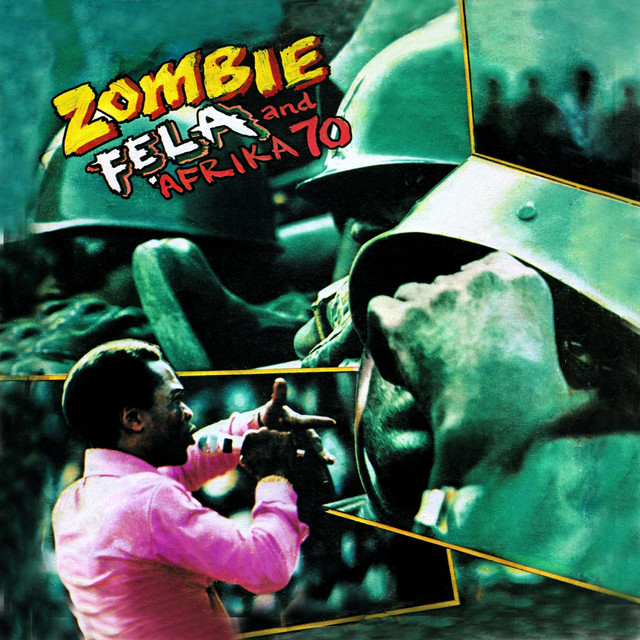

Founder of Afrobeat. Political activist. International Icon. The Black President. There are many names, monikers and titles which have been used to capture the influence Fela Kuti has had on the world – yet somehow, at the same time, not enough. He is a man who achieved so much, influenced so many, lives on and will continue to do so long after he stopped making music. He is the name behind my Album of the Week, with perhaps both his most influential and consequential piece of work: Zombie.
First released in 1976 in Nigeria (1977 in the UK), Zombie was nothing short of a searing attack on the Nigerian government, military, and its soldiers. The ‘zombie’ metaphor is used to describe the mindless following of orders by Nigerian soldiers, in a corrupt Nigerian military regime, over a powerful groove from him and the Afrika 70.
‘Zombie no go go, unless you tell am to go, zombie no go stop, unless you tell am to stop, zombie no go turn, unless you tell am to turn, zombie no go think, unless you tell am to think’
The reception in Nigeria was electric, and seemed to unify the people in a shared anger towards the government. Unsurprisingly, this infuriated the regime, who responded in a way which only served to strengthen the political messages of Fela Kuti and Zombie; they sent 1000 soldiers to Kuti’s commune, the Kalakuta Republic. Or, as Kuti would say, 1000 zombies.
‘Tell am to go straight, a joro, jara, joro, No break, no job, no sense, a joro, jara, joro, tell am to go kill, a joro, jara, joro’
The Kalakuta Republic was set alight, Kuti’s studio, instruments and tapes destroyed, and Kuti himself beaten. He would later claim to have almost been killed in the attack. Funmilayo Ransome-Kuti, Fela Kuti’s mother, was thrown from a window and was killed as a result of the injuries she sustained.
‘Go and kill! Go and die! Go and quench! Put am for reverse!’
Whilst a rightfully angering and mournful incident, it only goes to prove that Fela Kuti’s message was an important, vital, and powerful one – and it reached millions, raising awareness of the corruption within the Nigerian government.
As I sit and listen to Zombie, I am acutely aware of how far removed I am from his lived experiences, and the political messages and activism which are so core to his essence, spirit and sound. I was born and grew up in a city in the North West of England. I have very much a traditional white British upbringing. Yet when I listen to Kuti’s music, I can’t help but feel incredibly drawn to the messages and passion within his lyrics and instrumentation, and his fight against a problem which, technically speaking, couldn’t be much further from my own experiences in life. I think that goes to show two things: firstly, how incredibly good of a songwriter, bandleader, and musician he was; and secondly, how incredibly passionate, powerful, and influential his messages were – and to an extent still are. Just because you or I am not directly affected by an issue, that does not invalidate it. Yet, if it wasn’t for Fela Kuti, I might never have known about this. In a world forever plagued by people in power doing things to benefit the greedy, selfish, and cruel motives of themselves and their elite, musicians such as Kuti are so important. They raise awareness of issues which you might not be aware of, but should be.
Zombie is, in my opinion, one the most important and influential albums in Afrobeat, and music as a whole. It’s a record which should be listened to by everyone at least once, even if you have no real interest or admiration for jazz, afrobeat, funk or soul – but be warned, this might just convert you.
 Waxing Lyrical