


We’ve been lucky enough to sit down with Newcastle-based jazz musician Rivkala (pronounced riv-kuh-luh), in Waxing Lyrical HQ, to discuss her upcoming EP, Crushed Velvet, and the sounds, inspirations, and creative processes behind it.
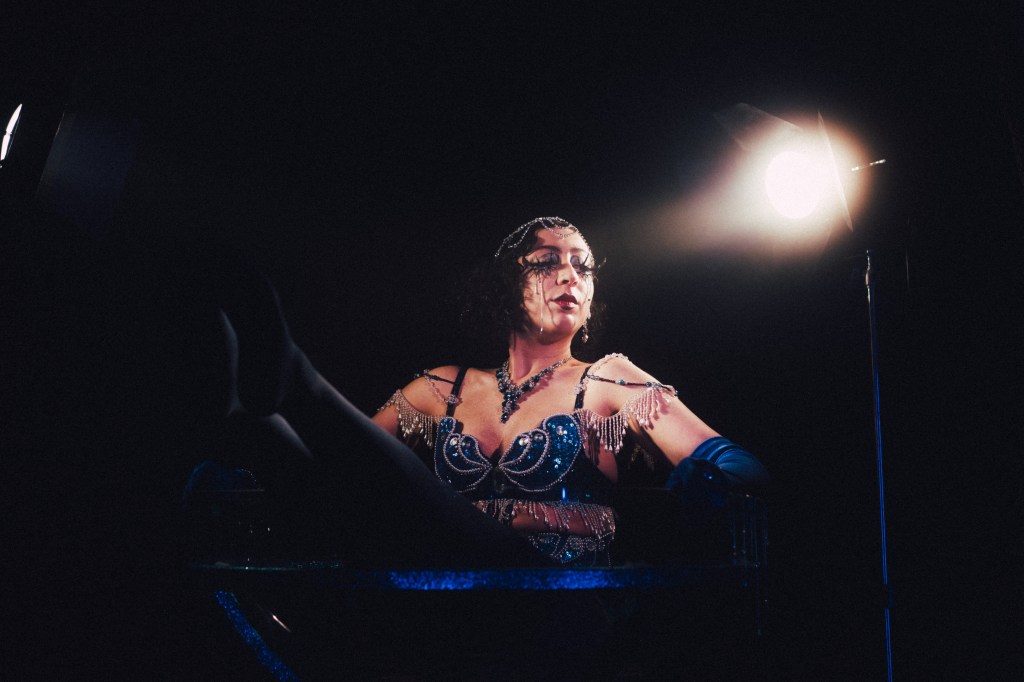
Rivkala has carefully crafted a musical world, and this EP tells a wonderfully narrated cohesive story. She welcomes us into the 1920s-inspired, swinging, cocktail-serving, burlesque Crushed Velvet cabaret bar, and tells us how it was born amongst friends.
“We were chatting about the project, and what the collection of songs was,” she tells us. “It started out with Chess, which is set in this bar. We went back and forth on a million different names, and there were so many that were just not it…then we found Crushed Velvet – we were like yes, that is the energy.”
“Crushed velvet is kind of tacky,” she continues. “Velvet is obviously this luxury thing – but crushed velvet…it’s cheap. It’s tacky. The ‘woe is me’ kind of vibe of the songs – it’s like whose the velvet and who’s crushed? this kid, you know…so it just felt like such a good cabaret bar name.”
From there, the concept for Crushed Velvet flourished and formed the focus of the project, becoming all but an actual cabaret bar nestled somewhere in central Newcastle, serving cocktails into the small hours of the morning.
“I’ll have loads of ideas, then I feel so lucky because I know so many brilliant people who can then help me elevate it,” she shares. “I’ve worked with great graphic designers, so I made the drawings, send it to them and then it comes back with beautiful texture and that extra level up. I love working with people who are good at what they do. It’s exciting.”
Although now the lifeblood of this project, the Crushed Velvet cabaret bar was not always the intention for Rivkala’s debut EP, she tells us. “For ages when I was first putting these themes together, it was just called Letdown. It was just this feeling of being really let down by the world and things not quite meeting your expectations, relationships or life, or the people who were supposed to be in power and have your back.”
“That was the core concept, and I think I’ve always been very theatrical and camp. I love storytelling and so any opportunity to get to build that out is so fun for me… I often play around with gender symbols, because I think everyone’s a showgirl. I think we’re all doing so much performance in our everyday life, whether that’s professionalism or masking neurodivergence; I think womanhood feels so performative to me sometimes, and relationship roles feel very scripted sometimes – I really enjoy unpacking that.”
It also taps into Rivkala’s feelings around being a performer, and the creating of a world has allowed her to express that more freely. “I think about the weird thing that we do, where we say: ‘Hey, everyone, just stop what you’re doing for a second and watch me.’ It’s such a weird thing, and I love exploring that.”
“Setting up this world, of this bar with the cast of characters – I find it really creatively freeing to have a little bit of separation from me as a person, because then I can actually access parts of myself that I maybe wouldn’t feel as confident to do if there wasn’t the kind of safety net of this isn’t fully me.”
– Rivkala’s Introlude –
If, after reading the name and digesting the EP’s imagery, you’re somehow still in doubt around the identity of Crushed Velvet, the EP’s opener, Introlude, is a perfect start. With blitzing keys and enchanting strings, it draws you in brilliantly to the world.
Compositionally, Introlude is aligned to both Rivkala’s intentions for the project, and her own identity. “I was really wanting to set the scene and introduce the characters,” she describes. “It’s actually an interpolation of two klezmer [traditional Easten European Jewish music] tunes, both called Rivkala. One’s a tango and one is traditional klezmer. We take the melody from one of them, and the lyrical story of one of them, which I retell in my words as the back story for this character.”
“It is the introduction of the band as well; It opens with this unbelievable keys solo from Ben Lawrence, who just let rip, and he is exceptional.”
Introlude, and the EP as a whole, maintain a distinctive feeling of the music being played in a live setting, the Crushed Velvet cabaret bar, thanks to its excellent production and an intricate attention to detail. “After the lyrics are over and it’s this scene-scape, I recorded a bunch of conversations with friends and family and wove things together to set up the themes of the EP,” Rivkala tells us. “There are so many moments of dialogue throughout the EP. Some are manufactured, some I just happened to be recording at certain moments, which is so fun.”
“There’s also bits from when we were recording tunes in a rehearsal room…I’d kept recording because I’d forgotten to switch it off. Towards the end, when everyone’s leaving, there’s a bit where we’re talking about sharing an Uber, saying ‘Bye, see you later.’ That was literally how we were all saying by at the end of the rehearsal. And I just forgot that I was recording.’
– Chess –
Chess is the oldest track on the EP, released as a single in November 2024, and has already made its way around Newcastle’s live circuit. If you’ve seen Rivkala live, you’ve likely been blown away by a rendition of Chess.
“This is one of my favourite songs I’ve ever written, because it’s so fun to perform and it’s so satisfying,” she tells us. “At this point I know which lines are going to get a laugh. That’s always really good fun to play with an audience that way and I’ve really worked on those deliveries.”
“I always write lyric and melody first, and then I’ll go and sit at the piano. I just had a couple of funny phrases in my notes folder.” Rivkala’s writing is witty and humorous, with lines such as – you wouldn’t let me peg you, so let me take you down a few – conveying her messages brilliantly with double meanings and clever laughs.
“I’m hugely inspired by hip hop in that way. I’m not cool enough to be a rapper, but so much of the kind of humour and storytelling that is such a core part of hip-hop is a massive influence on me and a massive influence on this track.”
“The time signature change just came out of me sat at home writing,” she continues. “I couldn’t decide [which to use], and so I decided I just don’t need to – I’ll do both. It felt so fun to then go into that walking baseline, the roaring kind of swing bit where it’s just really fun and explosive and then to come back and to play with those moments of exploding rage and frustration at this reality that I’ve been dealing with since I was 16 and started going clubbing.”
“It’s felt really nice to kind of reclaim an experience that has been a night ruiner, and to find the funny and to find the light in it. This is mine, now. This is my thing to be able to find the fun and the empowerment in it.”
As well as being a wonderfully written and told story, Chess also acts as a brilliant showcase of Rivkala’s band. “It’s so fun to be working with people who are so, so brilliant at what they do and to just give them space to do what they do,” she describes. “It’s like you wind up a toy and just be like ‘now go!’ They’re all just mint and I feel so lucky to be working with everyone. I try to find moments for that within the music and especially live, to just make the most of like how lucky I am to be working with these people.”
“I’m still pinching myself that this is like a reality, that they want to help me make my ideas into a reality and have done from the beginning. It’s been so affirming to have people that I look up to and respect so much musically believe in what I’m trying to do and want to be a part of it.”
– Vultures –
Producing an EP has clearly allowed Rivkala to incorporate a broad creative approach in a way which wouldn’t be possible by just releasing singles.
“The way that I imagine the EP is as an arc,” she tells us. “It takes you on the journey of the night through the bar, and you’re getting a bit drunker, and a bit drunker and a bit angrier, and then we get sadder. But before we get too sad, we’re angry. And that’s where Vultures sits.”
It’s a song written through angst and frustration, and it’s placed perfectly in the context of the EP, whilst slotting into the concept of Crushed Velvet.
“It was written from a real frustration at those with wealth, power and resources hoarding those things,” she tells us. “My dad works in the NHS and I have watched through his career those discussions around the dinner table of how things are on their last legs, underfunded and stretched thin.”
“I also work part time where I go into schools around the country. It’s given me such an insight into so many different schools around the country and how varying the levels of support and education are. Something that is quite universal is that staff are really overworked and underpaid. Health and education are the foundations of society and they are slowly being stripped back. That’s really scary to think about what that means and what that looks like for the future of creative industries, for the future of society. I’m not a big fan of the vultures.”
Sonically, it’s a high energy section of the EP, and the song’s rich and dramatic layers, through detailed strings and percussion, act as a perfect complement to Vulture’s themes and messages.
“It sounds like we worked with an orchestra, but it really was just Merle Harbron a million times,” Rivkala explains. “She’s incredible.”
“We referenced David Axelrod and that late 1960s sound that were trying to capture. It felt like this topic deserved that level of importance around it.”
– Bitter and Twisted (Bartender’s Lament) –
As our night at the Crushed Velvet cabaret bar draws on, we begin to enter the “angry” part of drinking – but illustrated through a unique perspective.
“Bitter and Twisted is from the point of view of the person who’s facilitating a lot of this, the bartender,” Rivkala tells us. “It’s about their take on why people are drinking and why people are trying to escape parts of themselves or their lives, and how they’re trying to do that – and how that pursuit is sometimes futile.”
Bitter and Twisted is a poem, and it’s delivered over a repeating, circular melody. It’s beautifully atmospheric, and captures the vibe of the bar perfectly – with ambient bar noise, various patrons’ cocktail orders, the taps of high heels, and shaking of cocktail making.
“It’s very inspired by artists like Jill Scott and Gil Scott-Heron,” she continues. “That kind of poetry and jazz fusion has always been a huge part of the art form.”
Building from there, Rivkala worked with producers and bandmates to build the picture and fit the poem into the Crushed Velvet world. “It became this massive scene-scape where you don’t know what voices are a real conversation or a dream,” she explains. “There’s sax and trumpet that I’ve distorted and processed. This is kind of the point in the night where we’ve drunk so much…the lines have started to blur and things are hazier. We’re getting a bit more inward and locked in to the chambers of our own head, which is where things start to get a bit sadder.”
Choosing to write a poem from the perspective of one of the Crushed Velvet bartenders was an element Rivkala was keen to incorporate into the EP: “I’m so intrigued and interested,” she continues, “with your fly-on-the-wall perspective, you see everyone at their worst. You must get confessions of absolute craziness. One person’s big night out – you see that every day. What have you learned from that experience? What patterns can you see?”

– All I Should Expect –
All I Should Expect eases in with a bluesy, soulful guitar, before settling into yet another sumptuous jazz track. Through percussive double bass, luscious horn backings, and shuffling drums, it builds steadily throughout and climaxes with a layer of strings and potently delivered lyricism.
“It’s a very dramatic song,” Rivkala tells us. “It was written from a pretty low place of despair and desperation – Is this all that’s ever going to happen? Am I just going to continuously be let down by men in my life? Is that just all that I should set myself up for? It’s about that kind of frustration of really not wanting to feel those things but it’s the evidence in front of me. This is the experience that I keep having.”
It’s another piece which has seen extensive exposure in front of a live audience. “It’s really nice to perform and have other women respond to lyrically,” Rivkala tells us. “I’ve had lovely interactions with people after gig, where they’ve said ‘you put words to something that I’ve always felt and not had had the ability to articulate’. That’s the best thing as a songwriter. That’s why I do what I do. I needed to write it for me but it’s nice that it can feel cathartic for anyone else as well.”
In the context of the EP, Rivkala describes All I Should Expect as contributing to the darker ‘midnight worries’. “Thankfully, I’m not in that mental space now when I’m performing it. But my job is to get there emotionally and to act that out because that is the purpose of that song. Those darker, midnight worries are often wrapped in a lot of shame, and I think that there’s something quite powerful about speaking light into them and acknowledge that they exist.”
– Last Orders –
The penultimate track on Crushed Velvet is a skit, which perfectly frames the final passages of the EP.
For Rivkala, this is hugely inspired by hip-hop. “Something that I love in great classic hip-hop albums is the incorporation of skits,” she tells us. “I’m thinking of The Miseducation of Lauryn Hill… It sounds like it’s just a guy hosting a club night and chatting to an audience.”
“It needed to set up for the plot of the EP journey. We’re going to get to Lonely Shade of Blue [the final track], where everyone’s left the bar and she’s on her own. We need to set that scene.”
To create the sound-scape, Rivkala called upon a local bar, where she has spent a number of years playing and nurturing her sound. “I went to Prohibition bar and I’m good mates with Danny, who’s the manager there. I wrote the script for him and he said ‘Absolutely, yes!’ I went with my little DIY setup and my Focusrite. He really nailed it.”
– Lonely Shade of Blue –
Last Orders sets the scene perfectly for the final of this EP’s seven tracks, Lonely Shade of Blue.
“It’s a very sad ending to the EP,” Rivkala tells us. “It’s very isolated. It’s a song written from a sad point. I was walking around Heaton Park and feeling a bit sorry for myself and I was just moved to write.”
“It feels like the most kind of inspired by that classic jazz ballad. Whether it’s an instrumental Bill Evans, or whether it’s a Billie Holiday or Ella Fitzgerald. Black Coffee was a big reference for it.”
“It’s simplistic in its composition and is literally just me in an empty room, at the piano. We put in aspects of Foley as well; there’s cars driving past, and there’s a church bell, and a conversation happening a street over. Other than those little aspects of detail, it is really a simple track.”
“It’s one of my favourite songs I’ve written because, both in the lyrical and harmonic, it feels like a homage to that Tin Pan Alley era of jazz songwriting that has meant so much to me. I’ve learnt how so many of those classic jazz ballad writers were also Jewish jazz musicians, like Gershwin and Sammy Khan. As a Jewish jazz songwriter, when I learn about Tin Pan Alley history, that was the Yiddish theatre district. It feels like continuing those legacies of songwriting.”
“People who then in the 70s, like Carole King who was also writing from the same street, from that same thing for within jazz and soul worlds. These are big heroes of mine, as well as obviously the Ellas and the Billies and Sarah Vaughan and these incredible titans of jazz. It feels nice to understand my own ancestral place within.”
“Even though it’s a sad note to end on, it feels really fitting.”
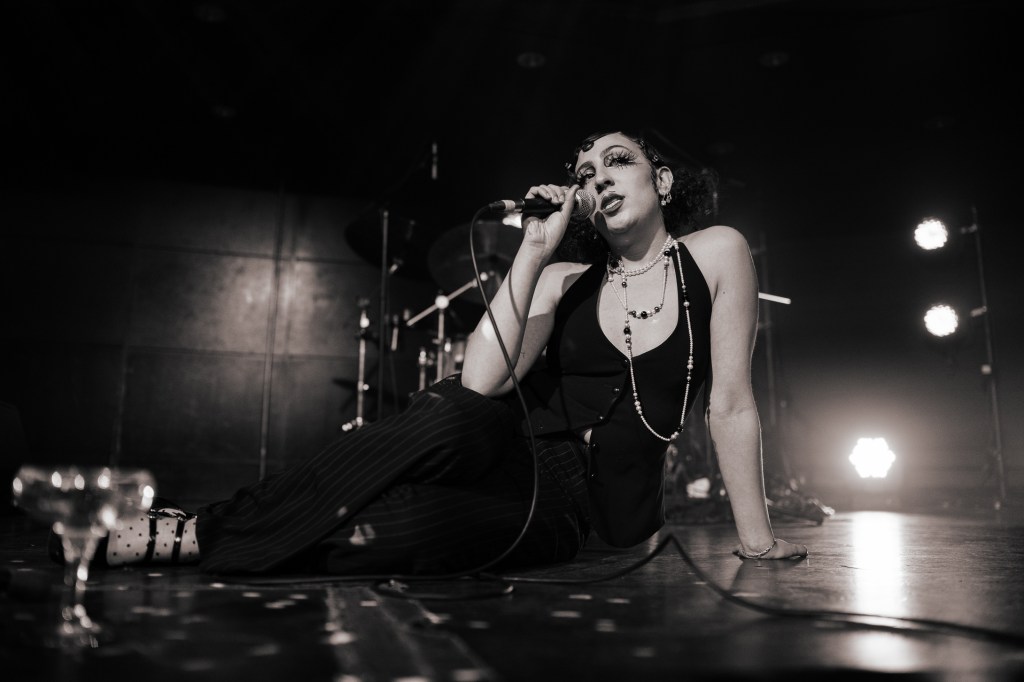
Crushed Velvet releases on June 6th on all major streaming platforms, but you can hear a taste and immerse yourself in the world at Rivkala’s EP launch show, which is taking place this Friday, May 30th, at Newcastle’s Cobalt Studios.
Looking further into the future, Rivkala is playing at what’s set to be a sensational night of jazz at Sunderland’s Fire Station, where she will be opening for saxophonist and hip-hop artist Soweto Kinch, alongside Theo Croker and the Joe Webb Trio.
For now though, prepare yourself to be engulfed into the world of the Crushed Velvet cabaret bar – complete with Rivkala’s six-piece jazz outfit, burlesque theatricals, and swinging prohibition glamour.
Crushed Velvet EP Credits
- Billy Bradshaw – trumpet, flugelhorn
- Luke Elgie – production, bass
- Ben Lawrence – piano, electric piano
- Merle Harbron – violin
- Sam Jamie – guitar
- Faye Maccalman – clarinet, tenor sax
- Adam Stapleford – drum, percussion
- Katy Trigger – bass, double bass
- Rebecca Dorit Tuck – Vox, piano, electric piano.
 Waxing Lyrical