
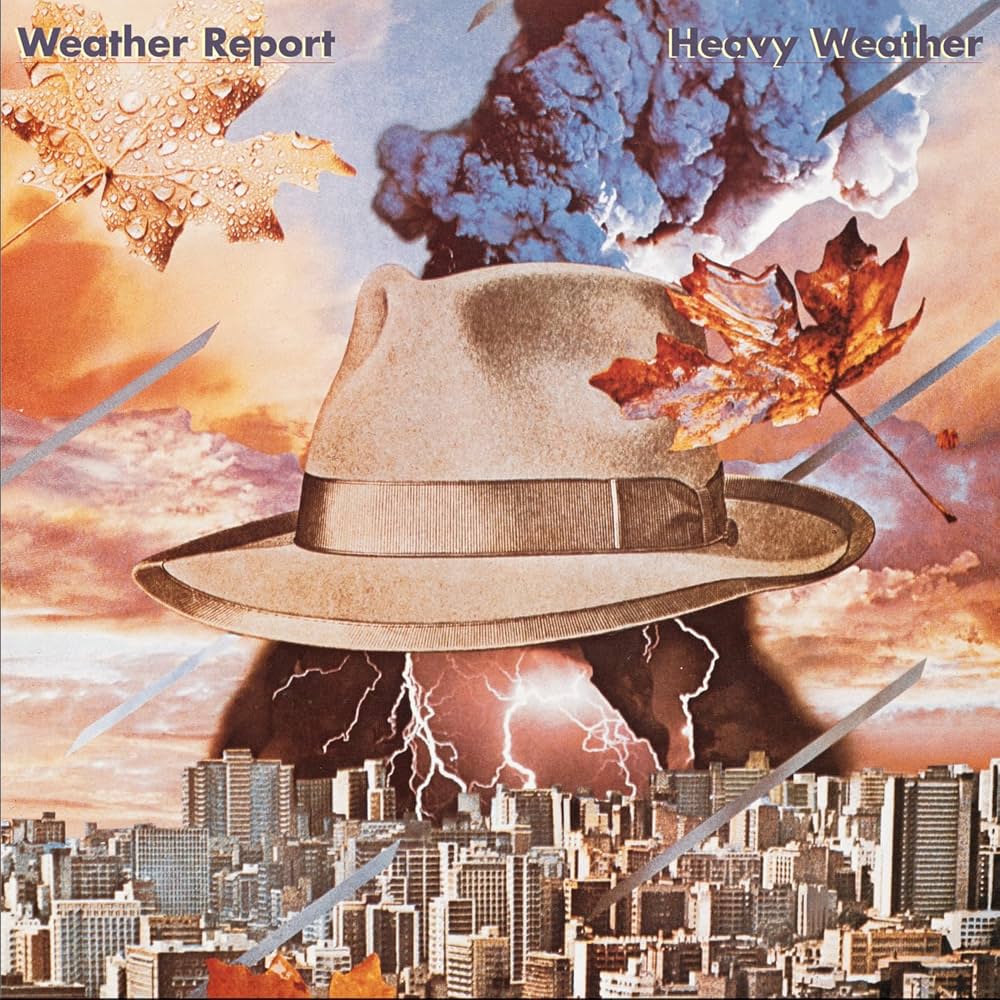

My Album of the Week is the product of a jazz-fusion group at their peak. From both a personal perspective, and backed up by its commercial success, Weather Report’s 1977 album, Heavy Weather, is the peak of their creative output and flair. Looking back, it’s also phenomenally influential.
Throughout their 16 years of making music, Weather Report consistently underwent a lot of change; over 30 musicians were in the group at one point or another, and they cycled through around 20 different lineups. Saxophonist Wayne Shorter and keyboardist Joe Zawinul were the only constant presences from 1970 to 1986, and the pair were pivotal to the group’s approach to jazz.
From the very start, Weather Report were built on collaboration, with solos, improvisation and equal input coming from all members of the group. This was a step away from the traditional and popular approach to making jazz at the time, which was generally to have a ‘lead’ instrument, accompanied by a band – take, for example, the Miles Davis Quintet (of which Shorter himself was a member of).
The line-up credited to Heavy Weather is: Joe Zawinul on synths, acoustic and Rhodes electric pianos, guitar, melodica, tabla, and vocals; Wayne Shorter on soprano & tenor saxophones; Jaco Pastorius on bass, mandocello, drums, steel drums, and vocals; Alejandro Acuña on drums and percussion; and Manolo Badrena on various different types of percussion and vocals.
Opening track Birdland is undeniably catchy, groovy and melodic. In its own right, the piece has become hugely successful – so much so, it’s become a jazz standard, and probably one of the most popular contemporary jazz pieces every made. Written by Zawinul for our Album of the Week, a version by American Vocal Group The Manhattan Transfer was a Grammy winner, and it has also seen hugely popular covers by jazz heavyweights Maynard Ferguson and Buddy Rich. Birdland‘s success is primarily down to the excellent songwriting of Zawinul, who was consistently one of the key factors in Weather Report’s success, including for Heavy Weather.
To me, the main factor which separates Heavy Weather from it’s predecessors, however, lies with another member.
In 1976, bassist Jaco Pastorius joined the group. I don’t think it’s a coincidence that just a year after Pastorius joined, Weather Report suddenly reached their peak. I’m likely a little biased, being a bassist myself, but I think Pastorius’ involvement and influence in this era of Weather Report cannot be understated. His signature fretless bass playing, melodic frills and explorations with harmonics and chords has always left me in awe.
Pastorious’ flair can be clearly heard throughout Heavy Weather, and not just hiding in the shadows.
Teen Town is one of my highlights of this album, and it is a Pastorius masterclass. It’s a percussive, driving bass feature, which is technically impressive, whilst also retaining a funky groovy and head-bopping feel. With simple drums, plucky synths, and minimalist backings, it’s all in the bass. Teen Town is another track on Heavy Weather which leaves a serious legacy; US funk group Vulfpeck’s iconic hit Dean Town, from their 2016 album The Beautiful Game, is a clear homage to the track, and Joe Dart plays a great tribute to the 1977 classic.
Jaco Pastorius no doubt gave the band a busier, more exciting output, which is perhaps unusual for a bassist. Most importantly of all, though, Heavy Weather is the aggregate of five brilliant musicians, who each brought something different to the table. From Acuña and Badrena’s furious percussive flair on Rumba Mana, to Shorter’s injections of free jazz saxophone throughout the album, and Zawinul’s funky and catchy songwriting on huge hits like Birdland, complemented by Pastorious’ dexterous, melodic bass playing, Heavy Weather is a monumental jazz-fusion record.
 Waxing Lyrical