
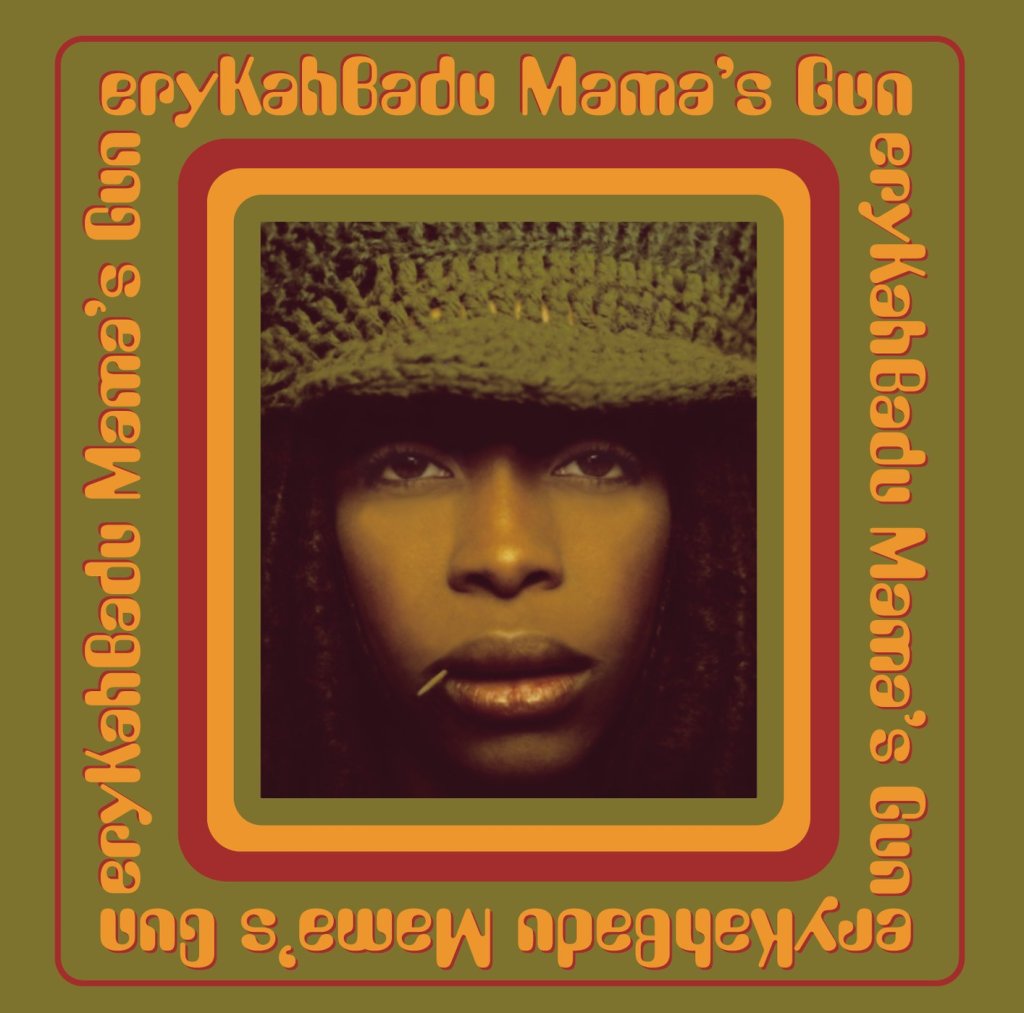

My Album of the Week is the second studio release from Erykah Badu – Mama’s Gun – released on the 18th of November, 2000, on the Motown Records label.
It seems to have ended up as a rather fitting pick this week in particular, for more than one reason.
The main reason I wanted to wax lyrical about Mama’s Gun this week in particular is because the album is turning 25 in November, and Badu is taking the album on tour for a run of anniversary shows, including two nights at the Royal Albert Hall this Friday and Saturday (24th and 25th of October). Before I even dive into the intricacies of album itself, I think this speaks volumes. Nearly selling out two nights at the Royal Albert Hall for an album 25 years old is impressive, and a testament to the legacy of Mama’s Gun.
I’m not normally one to dwell on pop-culture, tabloid journalism, and the personal lives of my favourite celebrities, but I feel that the context of this record is important – both for Badu personally, and those in the rising neo-soul scene around her. From 1996-1999, Badu was in a relationship with André 3000 (Outkast), and they had a son in 1997. Mama’s Gun was Badu’s first release since his birth, 3 years later. Erykah also suffered heavily from writer’s block following her debut album, Baduizm.
I think this is vital to the music created and messages conveyed through Mama’s Gun. Love and heartbreak are key themes through the album’s 15 tracks, alongside exploring societal injustice; notable highlights include Green Eyes, which beautifully captures the emotions following a break-up, and A.D 2000, which is a reference to Amadou Diallo, a 23 year old Guinean student who was shot dead by NYPD officers in 1999.
Mama’s Gun also marks a shift to a laid-back, soulful jazz sound by Badu, along with elements of funk, rock and reggae in places. Primarily, I would classify the record as neo-soul, but it meanders through genres seamlessly – from the funky, groovy opening track, Penitentiary Philosophy, all the way to Orange Moon, a soft, jazzy ballad vibe.
Whilst the genres may not be consistent, one thing certainly is: the musicianship. Badu enlisted drummer Questlove, bassist Pino Palladino, and keyboardist James Poyser to help with the project. What was emerging in this period of the late 1990s and early 2000s would be the golden era of this neo-soul sound so perfectly captured by Badu. Whilst working on Mama’s Gun, Questlove was also contributing to D’Angelo’s Voodoo (2000), Common’s Like Water for Chocolate (2000), and Bilal’s 1st Born Second (2001). As each individual project developed, the artists became closer, and eventually formed the Soulquarians, amongst a handful of other musicians (including J Dilla, Roy Hargrove, Q-Tip, Mos Def and Talib Kweli). The Soulquarians were a collective of Black music artists, and Mama’s Gun is one of the most iconic albums to come from the collective, epitomising their sound, style and focus on the collaboration of legendary soul musicians.
It would be wrong of me not to credit some of the other, not yet mentioned artists who made Mama’s Gun such a special album: Roy Hargrove is credited as responsible for the horn arrangements throughout the record; the late, great Roy Ayers provided vocals and vibraphone on Cleva; Nathan Hale and Isaac Hayes contributed to the composition of Bag Lady; Stephen Marley (son of Bob Marley) played multiple instruments and provided a vocal duet with Badu on In Love With You; and keyboardist Shaun Martin provided composing and keyboard skills throughout the album.
I mentioned at the start of this feature that there was more than one reason for this week’s album being so relevant, alongside it being the 25th anniversary of Mama’s Gun. The second is, of course, that the world lost a musical legend this week – a founding member of the Soulquarians, and one of the best R’n’B artists to ever make music, D’Angelo. Voodoo was released just months earlier, and Mama’s Gun was described as its ‘female counterpart’. Whilst he may not have been directly involved in my Album of the Week, I’ve no doubt his solo work and that with the other Soulquarians members impacted this record in some way or another. His soul legacy is undeniable.
 Waxing Lyrical