

If I’m being honest, I’ve only really developed a true appreciation for ambient music over the last year or so. If there’s one thing I’ve learnt during this time, it’s that what you can’t hear is equally as important as what you can. For far too long, I compared ambient music to other genres, typically coming to the conclusion that it simply doesn’t equate to the usual records I spend my time listening to. That’s because it doesn’t – but not in a bad way.
Ambient music shouldn’t be compared to rock, jazz or hip-hop, or funk, soul and RnB. It needs to be appreciated in a different context. In its own context. It’s a powerful art form when used correctly, and my Album of the Week is a perfect example of this.
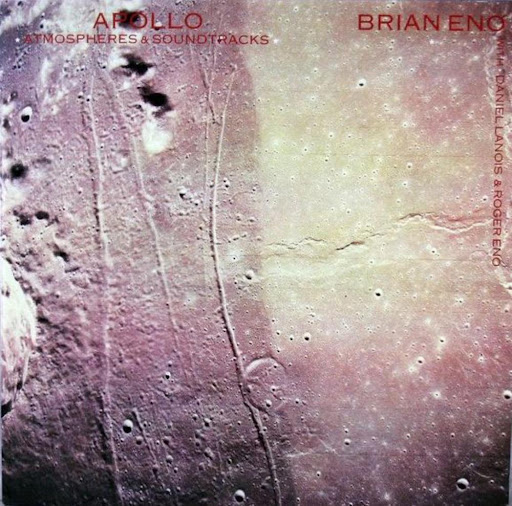
Apollo: Atmospheres & Soundtracks is a studio album by Brian Eno, released in 1983 by EG Records. The record was created with Eno’s younger brother, Roger Eno, and Canadian record producer and musician Daniel Lanois.
Known as the father of ambient music, Eno has been an incredibly influential figure both in ambience and the wider worlds of rock and electronic genres. It’s actually an interview Eno did with the Guardian about this very album which really makes ambient music ‘click’ for me, in a way:
“Around the time of Apollo I was listening to a lot of film soundtracks. What I liked was that they represented a form of incomplete music, where the missing element was the visual element. I liked making music that somehow allowed the listener to imagine a visual element themselves.”
That is the beauty of this album and this genre. The emptiness and nothingness, which is an integral part of ambient music, allows you as a listener to fill that space. This can make it very subjective, and allow the music to complement a visual art.
Is there a better album to demonstrate this, than with a record which was written as an accompaniment to a documentary about outer space and moon landings?
As the name suggests, Apollo: Atmospheres & Soundtracks was inspired by NASA’s Apollo programme, and was written for a documentary film covering Apollo 7 through 17. The documentary would not be released for another 6 years, and ended up being titled For All Mankind. The idea that this record was not made to be the main focus of your attention really puts into perspective everything it represents and intends to be.
Anyone who is familiar with Eno’s will know track 5 – An Ending (Ascent). I truly believe this to be one of the most moving and beautiful pieces of music ever recorded. Depending how I feel, An Ending (Ascent) can be anything from solemn to uplifting, and evoke feelings of awe, despair, or simply an indescribable sense of life. As well as its use in the Apollo documentary, An Ending (Ascent) has also featured in films and TV such as 28 Days Later, Trainspotting and Top Gear, the start of a Coldplay concert, and the opening ceremony of the London Olympics. I’ve even heard of it being used to soundtrack a WWII museum exhibit on the holocaust.
The variety of settings Eno’s music has been paired with is a testament to its versatility and sheer emotional power. It demonstrates powerfully the ability of this album to evoke all manner of human emotions, and the importance of the setting or headspace you are in. You can listen to this music on the bus, sat in the park, or people watching from your local cafe; you will feel something, and probably something different each time. And that something is entirely dependent on everything else going on in your version of the world. Context is key.
 Waxing Lyrical