
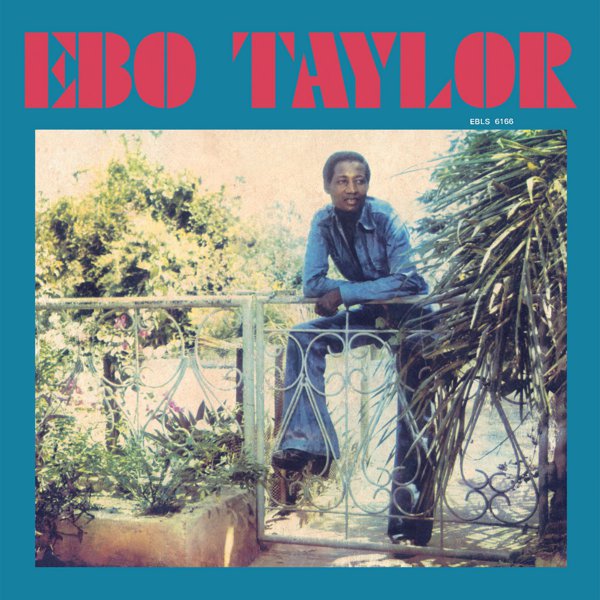

In 1977, Ghanaian musician Ebo Taylor released his first solo LP – the self-titled Ebo Taylor. He’d been an important player in West African music long before this, though.
Ebo Taylor was born in Cape Coast, Ghana, in 1936, and learnt to play guitar whilst at school. By the late 1950s, he was not only a popular and in demand musician, but already a very influential one. After starting with the Havana dance band at 19 years of age, he went on to join highlife band the Stargazers in Kumasi, where he gained his first studio experience and mightily impressed on his guitar. Two members of Stargazers, saxophonist Teddy Osei and drummer Sol Amarfio, would later form British Afro-Caribbean rock band Osibisa. After his stint with the Stargazers, Ebo Taylor then progressed to the Broadway Dance Band, another popular highlife band, where he would eventually become its musical director. He joined the The Eric Gilder School of Music in London, and, before long, he formed the Black Star Highlife band. He moved back to Ghana, working with the likes of Pat Thomas and Tommy King, and producing for a variety of Ghanaian musicians. Ebo Taylor was also friends with Fela Kuti – they studied and jammed in London together. It could be said that what Fela Kuti was to his native Nigeria, Ebo Taylor was to Ghana.
The point is that this all came before the release of our Album of the Week – Ebo Taylor. This record came at a time where Ebo Taylor was already highly respected in the world of highlife and Afrobeat.
The first track I ever heard from Ebo Taylor was Heaven. It’s one of those tracks I just knew I would fall in love with instantly. The energetic, horn-backed lick which introduces the song is followed by Taylor’s band settling instantly into a funky, highlife groove with Taylor’s guitar noodling over the top. Heaven is the penultimate track on the Ebo Taylor LP, and one of his most popular.
After properly taking the time to explore Ebo Taylor’s discography, I soon discovered Heaven is not a fluke. Out of all his work, this self-titled album is definitely my favourite. So much is packed into a short 34 minutes; soulful and delicate running guitar lines and whirling organs swirl around in album opener Saana, whilst a strong horn section lead the line in tracks Bra and Ohye Atar Gyan. Hypnotic, chanting vocals, primarily in Taylor’s native Ghanian language, occasionally dip into English – whilst some songs are purely in English, such as opener Saana: “Hey baby, You look so nice…”
This record is a magnificent showcase of Ebo Taylor’s talent not only as a guitarist, but as a composer, arranger and bandleader. For an artist with as deep a discography as Ebo Taylor, it’s not easy to pick out the best. For me, this album is definitely up that. In fact, the album artwork, featuring a young Ebo Taylor leaning over a fence in his bootcut blue denim, was used as the basis for his 2011 compilation album, Life Stories. This came only a year after Ebo Taylor’s first album to be internationally distributed (Love & Death). It may have taken six decades, but it just to goes to show the enormity of the influence Ebo Taylor continues to have, and will continue to have many years after his passing. So what better album to celebrate his life than his seminal 1977 release?
I have no doubt that Ebo Taylor’s legacy within Afrobeat and highlife will live on for generations to come; as global sounds become ever more popular across the world, Ebo Taylor ought to be regarded as offering the manuscript for Ghanaian music. An incredibly influential musician, genre pioneer, and collaborator, he will go down in the history books as a founding father of West African music, alongside legendary figures such as Fela Kuti, Ali Farka Touré and Tony Allen.
 Waxing Lyrical