

Guest review – Josh Weir
Jazz, I would argue, has evolved the most of any genre over the course of time. It has always been changing. Yet most people would say that it’s dead, and stopped being popular somewhere in the 70’s. They’re wrong (sorry). Jazz is very much alive, and while it does still exist in the way people tend to imagine it, that doesn’t mean it stopped in its tracks. It instead took a piggie-back ride on the back of hip-hop through artists like A Tribe Called Quest, who helped to establish the genre of “jazz rap”, where it was still present, but its influence far more subdued.
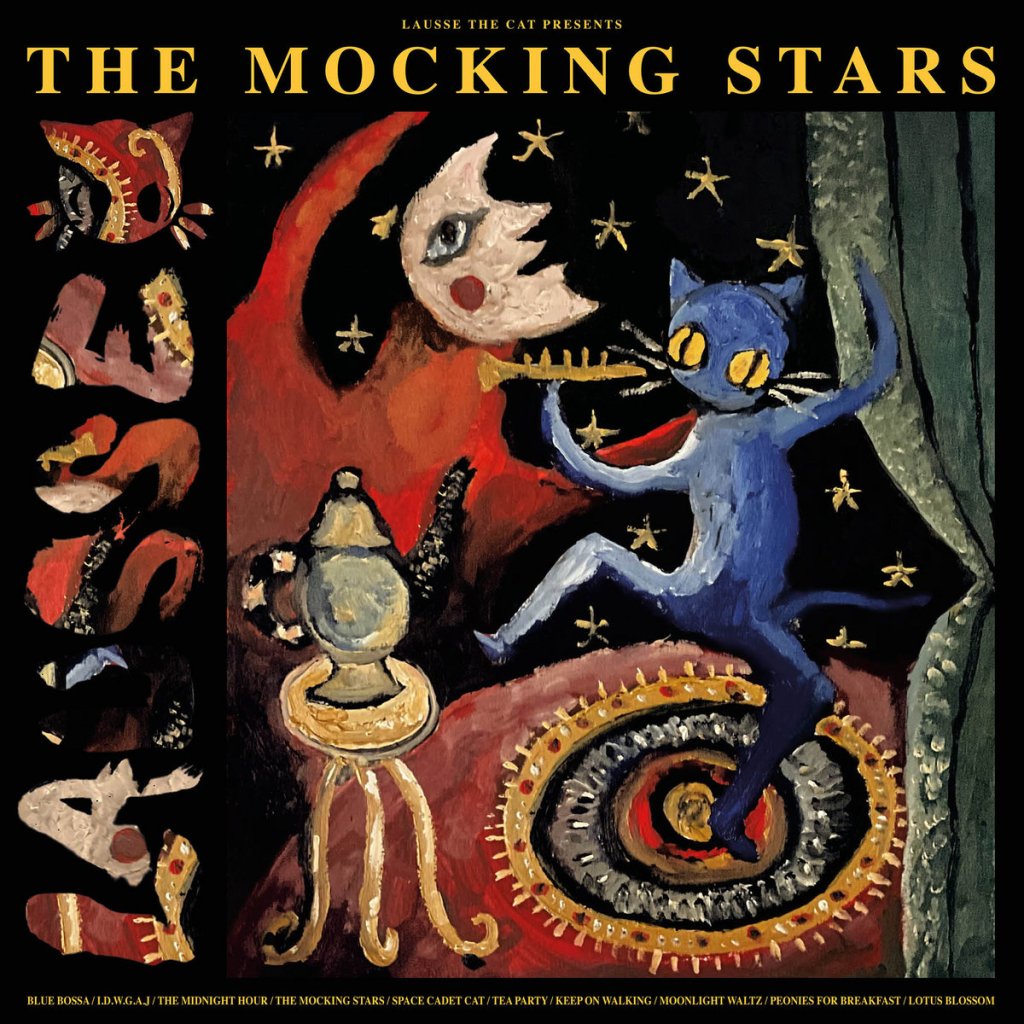
Recently, artists like Loyle Carner and Little Simz have begun to tap back into jazz’s DNA, utilising more complex harmonies, acoustic-adjacent instrumentation, and beats that are more relaxed – harkening back to the feelings found in the cool jazz movement. A great example of this is the newest release from the anonymous rapper toting the moniker LAUSSE THE CAT, with his album The Mocking Stars, released 7 years after his previous record.
How does this album embody jazz exactly? Well firstly, it does so in spirit. An essential part of creating jazz is through studying the music of the greats and learning the nuances of the genre throughout its development in history. Since LAUSSE THE CAT is anonymous, how can we tell if they’ve done this? One sign is how the album is bookended by songs that share their titles with compositions by trumpeter Kenny Dorham: Blue Bossa and Lotus Blossom. This is a possible coincidence, sure, and while it doesn’t have a huge effect on the album knowing this, I think it is more likely to be a subtle homage for those who are in the know – an easter egg to those of us who have done our homework.
Jazz is often thought of as a very serious, intimidating genre of music to play. It’s very easy to see where this comes from, with its arguably toxic culture in regards to practice and other facets. But this has never been 100% true. Musicians like Dizzy Gillespie and Louis Armstrong are notorious for their jolly nature. The key is having a jovial concept, but playing with integrity and sincerity. LAUSSE THE CAT is not afraid to have fun on this album either. His interpolation of the song Cats on Mars from the soundtrack to the anime Cowboy Bebop at the end of his track Space Cadet Cat is topical to the narrative of the album, tastefully done, and hilarious when connected to its original song and its use within Cowboy Bebop. Compare it to the song Salt Peanuts; the song is your standard blistering bebop tune with amazing improvisation from the band, but when it comes to the whole band shouting “Salt Peanuts! Salt Peanuts!” you can’t help but smile.
When it comes to the actual music of the record, the three features of jazz influence in rap music I mentioned before are found all over the album, but I want to highlight it in particular on the song Blue Bossa. Complex harmonies? The chords are extended and follow passages that are typical of chord progressions in jazz. Acoustic-adjacent instrumentation? The first half of the song primarily features the vibraphone, an instrument used by artists throughout the genre’s history, such as Milt Jackson and Joel Ross. Relaxed beats? The combination of LAUSSE’s laid back delivery with the latin-influenced rhythms helps to put us at ease while listening.
So why does any of this matter? Well, I’m glad you asked. When it comes to jazz, people often try to put it in a box. “Jazz is this,” and “jazz is that,” I hear them cry. Well who are they to say what it is? I say that if it’s steeped in the culture and delivered with honest intent, then it’s jazz. Is this a hip-hop record that has some elements of jazz in it? Or is this album an example of how the genre has evolved to use other styles and mediums, such as rapping, to express new ideas in a way that we didn’t think of in the genre’s heyday? I firmly believe in the latter, and in the expansion of the genre’s borders over time, but who am I to say what jazz is to you?
 Waxing Lyrical