

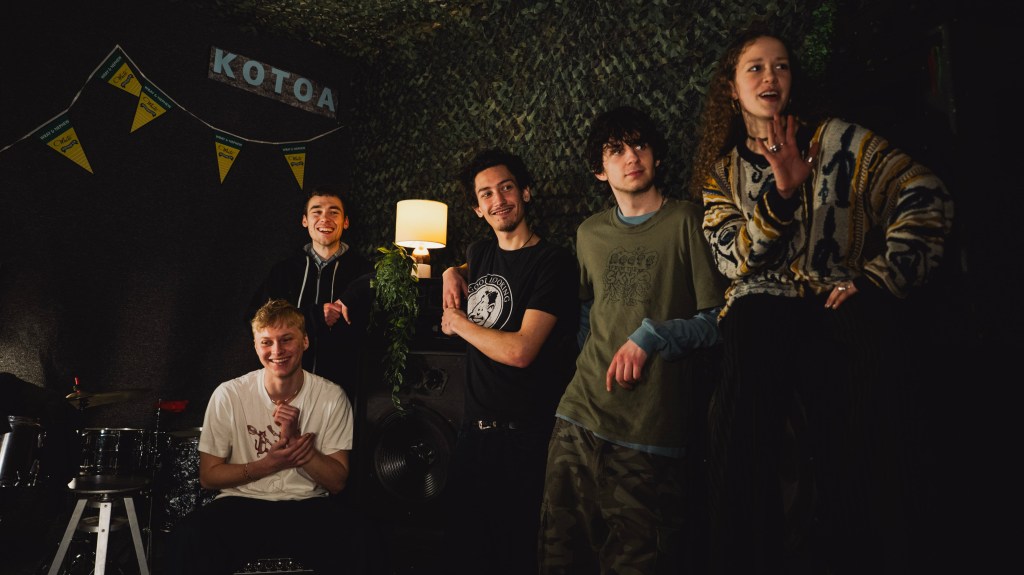
In the heart of Loughborough Junction, I met with South London band Kotoa in their studio. It’s a typical London creative haven: cosy, difficult to find, and nestled between various industrial units.
Kotoa are a five piece group, made up of drummer Laurie Campling, bassist Frank Black, keyboard player Sam Hillier, guitarist and vocalist Memphis Koloi & saxophonist and vocalist Maia Avery. I sat down with Maia, Sam and Laurie to chat about all things music. It’s local election day and Laurie is running a little late.
Maia starts by introducing me to the group’s music. “We play a mixture…” she begins. “Predominantly dub, Afrobeat, reggae, jazz fusion…but it’s very much a mixture of everything. We couldn’t decide at the beginning and that’s actually what has helped us create our own sound, which has been pretty cool.”
“I would say it’s a mix of almost the sounds of London, in a lot of ways,” Sam adds. “It’s not necessarily rooted in one genre but it’s inspired by a lot of different sounds that you would hear, especially in South London and in and around the area that we all grew up in.”
Kotoa have been making music together in one way or another since they were all at school, with the Kotoa project officially forming in 2024 when the name was coined. “Kotoa is a Tongan word for togetherness,” Maia explains. “The reason we came up with that is because Memphis is half Tongan and his dad, Paul Koloi, is Tongan. He’s helped us so much as a band…the support he’s given us, but also what he does for the community in general is just really inspiring. Everyone here will know him or know of him. He’s a community man, and I think a lot of our values aligned with that, so we thought we’d do a little tribute to him. Then, when I saw it written down, it also just looked really awesome, and you could do a lot with it. It was a lot more unique than anything else, and it has a deeper meaning than just a name.”
Sam agrees, adding: “It resonated in the sense of when we or anyone plays live music that resonates with a group of people that will kind of bring them all together as a crowd.”
The opportunity to have their own studio is hugely important to Kotoa, and allowed the band to elevate the project to a different level. A stone’s throw from Loughborough Junction station, it is central to where the five members grew up. It’s a small but cosy space, and every bit of it is lovingly decorated with various tapestries, prints and album covers dedicated to inspirations and heroes. “This space actually gave us somewhere to properly lock in for a bit and give us a space to properly create music,” Sam tells me. “It’s a dedicated space to music, which is really useful.”
After securing their own space, Kotoa were able to fully focus on creating their own music. In November 2025, they released their first EP: Earthwise. It serves as a strong showcase of their varying inspirations and sounds, and offers a surprisingly deep insight into the group in just over 20 minutes. “Those 5 songs were compiled together,
but they weren’t necessarily all made with the idea of that they were going to be part of an EP,” Sam tells me. “They were the best songs that were all original and the best songs that we’ve been playing live.”
“We felt these were the songs that felt like us when we played them,” adds Maia. “They are all very different, but we wanted our 1st EP to be different – just to show the diversity of music that we create.” She adds: “Earthwise was the first tune we wrote as a band ever. That was in Frank’s living room. We played it one time and we went: ‘that was actually really kind of good!’”
Earthwise is the final track on the 5 track EP, and fuses dub and jazz to create a smooth but groovy track. Other tracks on the EP introduce elements of highlife, soul and much, much more. “I think the main thing that we liked about all of them was displaying our sound and all the different variety of sounds within that,” Sam explains.
One of the biggest challenges in curating their first EP was deciding on a tracklist, Maia tells me. “There was probably about 7 songs we might have had the idea of including. Some of them were easier to choose than others; for example, when we first had I Am, that was one of our biggest moments of like ‘oh wow, we can actually create something really great.’”
“One of the tunes, Charge It, was a massive learning experience,” she continues. “Because live it’s one of our favourite songs to play and everyone loves it…but we weren’t used to recording songs at all – we’re a live band. So when we went to record it, it’s not great recorded, which was kind of a weird thing for us because we really love it. It taught us a lot.”
Sam adds: “It’s also about trying to find within those five songs, texturally and in the sound, how they kind of connect with each other…obviously they’re different songs, but there are ways within that to make them sound similar to each other. For example, some of the synths that I use would connect songs to each other. In Thieves and Scammers and Higher Being there are similar sounds…so there are little ways of finding similarities.”
“I think dub is probably the reason,” Maia adds. “Dub is something that you can apply to basically anything. It’s about twisting sounds and experimenting and so I think in all of those songs, apart from I Am, there’s dub.”
A band with a sound as rich and diverse as Kotoa is, unsurprisingly, also deep in influences and inspirations. “Fela Kuti is probably an overall inspiration for a lot of reasons,” Maia tells me. “Whether it’s his actual [music], or what he stood for. He was very political with his music, and used music as a tool…that is inspiring for us. A personal one, especially for me, Frank and Memphis is a band called Soothsayers because we were brought up with them; They taught us music. The way I play is very much inspired by the saxophonist.”
Alongside the more obvious inspirations which can be directly heard in Kotoa’s music, subtler influences are also vital, Sam explains. “For me, a big inspiration is Massive Attack. In terms of the message, The Clash – what they were saying, what they were speaking about. Because that’s a bit more close to home in the sense that they’re from London, and they would talk about the problems here… 4hero – they put live instruments with jungle, also in the UK. That’s a big inspiration, especially for one of the songs in the new EP, and they’re very jazzy.”
“A lot of sound system, especially from Frank, he’s massively inspired by sound stuff. That’s his sound system there,” Sam adds, as he gestures towards a ceiling to floor stack of immense looking speakers.
It’s clear that Kotoa are very much a product of London’s music and the intersections of the city’s cultures, legacies and soundscapes. “We have our own event here, which helped us a lot to grow,” Maia says. “That’s helped us get better at performing in front of a comfortable audience and our stage presence from doing those nights completely shifted. We’re not doing them so much anymore, but they were very useful for us. There’s some nights on Wednesdays called We Are Many. It’s not that that’s necessarily influenced us as a band but it’s a really incredible template of what music can do. Seeing the free community music that’s provided and the level that people are at from jamming with each other is really inspiring.”
She continues: “The Fox and Firkin in Lewisham – we did our EP launch there. We’ve performed there a couple of times. It’s just always amazing.”
“That venue is especially great as well because so many crazy people have played there,” Sam adds. “It’s been there for so long and it’s such a great community venue, and they always book local talent.”
Kotoa recently had the opportunity to play some very special shows in some of London’s most iconic spaces. “We played at Union Chapel for three nights,” Maia tells me. “That was mad…It was some of the best gigs we’ve ever done because we’re playing to an audience who don’t actually know us. We were like ‘we need everyone standing up and dancing!’ But actually, the energy we got even from people sitting down taught us that our music can be enjoyed in lots of different ways.”
“They needed someone to support Gary Bartz…that was pretty surreal. The two nights before that, Fred Wesley & the new JBs were playing, and their support act dropped out. They said ‘do you want to do the support for him as well?’ It was pretty terrifying, pretty imposter syndrome…we did it and people really loved it, and it was a massive learning experience.”
“It was a very different crowd from what we normally played in,” Sam tells me. “For us to sit down and then start playing what we play – they all looked a bit surprised. It’s quite a nice feeling just seeing loads of heads like going like that [he nods his head]. Because they’re all sitting down, it’s kind of our job now to make these guys move in some way.”
By this point, Laurie arrives at the studio. He apologises and explains how he had forgotten his ID to vote with. I tell him it’s fine; I am just relieved that his priorities are in the right order.
He joins the conversation to discuss his inspirations and influences a little further, starting with the relationship between music and politics. The implementation of strict anti-protest laws by then home secretary Suella Braverman – which have since been quashed for being introduced unlawfully and unjustly – holds particular significance. “Music and gigging and raving and everything that comes under the music umbrella became a form of protest in disguise, in that you didn’t need the government’s permission. I think since fascism has risen up, gigs have become such an important, strong way of letting people protest and express themselves.”
“What’s also important about music as well is that there’s so much negativity being fed to us all the time,” Maia adds. “What I like about our music is that its commenting, absolutely, but is doing it in quite a hopeful way…I think it’s really important to provide liminal spaces where people just let go. Ensuring you’ll have these brief moments of pure happiness and letting go builds that emotional strength to carry on. Going to gigs and talking to people, or going to different places in the world and meeting people who are so different from you, and somehow relating to each other over music because it’s that universal language is just so amazing. I hope that we provide these joyful places.”
Not just in a political sense, but also a personal sense, Sam appreciates the bigger picture with music. “Music will take you somewhere and maybe make you feel better. Healing is actually a thing we talk about a lot through music and the trance thing – like with Fela [Kuti] that was very big. It’s almost like you’re becoming a trance. It’s very similar with sound system culture, with raves and everything.”
Reflecting further on her own personal inspirations in music, Maia explains to me the importance of music from different perspectives other than just enjoyment. “I’m quite inspired by the origins of music, for literal practices of living, rituals, etc. It kind of fractures the world between reality and maybe this other world and in connecting to nature…seeing how powerful music has been across cultures, across time, since the beginning of humanity. It’s the most raw form of communication and being human, I think.”
Kotoa are currently in the exciting process of preparing to release new music, ahead of a very busy few months. “We have got our 2nd EP, Out of the Dark, which is coming out in the summer,” Maia tells me. “Our first single is coming up at the beginning of June, which is really exciting. This EP has been really amazing because we have learnt so much, even just about recording processes, what you need to do and what you need to be prepared for.”
“It’s naturally a development of our sound,” Sam adds. “Some of it is more complex songwriting and some of it just trying out different sounds and different roots.”
Speaking of the relationship between the forthcoming EP and its predecessor, Maia expands on the bridge between the two. “I think it’s a continuation… the themes are still very, very similar. It’s just a more developed Earthwise. This one is a little bit more curated than the last one. There are themes going on with a lot of the songs and there’s a little bit more synergy between them. But they’re all unique pieces of work as well. It’s still political, but this one is a bit more hopeful, I think. It’s just a bit more joyful and less on the nose politically.”
Laurie also reflects on the challenges the group have encountered along the way: “We are 5 people who are in a project and it’s shared very much equally. We’ve got this really perfect dynamic where no one has any power over anyone else, but things like coming up with the EP cover and coming up with merchandise and this kind of strategising – I’d say it’s the hardest part of being in a band. The music comes to us naturally; this kind of thing doesn’t. Most tensions come, not because of these conversations, but it’ll be around the time of these conversations – just because there’s a lot of friction happening anyway.”
“There are things you forget about,” Sam adds. “There’s actually so much more that you don’t see going on behind the scenes. It does take a lot of time up.”
As the EP release edges closer and closer, Kotoa have their sights set on a packed line up of gigs and events coming up. “We’ve got an incredible festival run this summer,” Maia tells me. “We Out Here is probably our biggest one; that is one of our inspirations I’d say. One minute you’ll be going to drum and bass, and then the next like deep spiritual jazz – yet everyone is connected somehow. We love it anyway and so to be able to go and play our own original music is really exciting.”
“It’s an absolute honour to have been invited to play there,” Sam agrees. “This will be our fourth year of going. It’s the first time for all of us to be going and playing our own tunes there, which is just mental. And then if you look at some of the greats that have played there – loads of amazing artists have played there.”
Before taking to the stage at We Out Here, Kotoa have also secured slots at Boomtown & Kendall Calling, amongst others.
“We’re going to be playing to people who don’t give a f*ck about us.” Maia shares. “And that’s the best kind, because even if you get one person out of that crowd who follows you, that’s one more person than you ever had.”
Laurie sees the summer run of shows as an exciting opportunity to spread their message and music. “We’ve all said that the goal is that we go to these big festivals, where huge names are playing on the big stages. But we want people to leave the festival and be like: ‘they were cool, but that band we saw in that little tent on that night was the best thing of the whole weekend.’ That should be the goal.”
Further ruminating on their upcoming live shows across the country, Laurie has also found himself recognising the privileges associated with being a London-based musician. “I can pretty confidently say if you’re in London, and you’re making really good records and you have an authentic, unique sound, you will pretty quickly get spotted and signed. I think if you’re living out in the sticks, that’s a lot more difficult… it’s very valuable being from London. We’re all grateful.”
“We’re so fortunate that we’re exposed to this kind of music in this such a deep way,” Maia expands. “You go to these smaller towns with people who are like: ‘I love this music – I’ve just never had access to it.’ So hopefully we can spread it more.”
From listening to their music, exploring their schedule, and chatting with the band, one thing seems certain; Kotoa are only just getting started. With one EP under their belt and another imminent, the future is looking bright for this five piece who are fusing the entirety of London’s musical scene into one exciting and polished package. Be sure to listen to their music, and keep an eye out on their socials to see where you can catch this group live.
Kotoa’s latest single, Love and Light is out now; it is the first from their forthcoming EP, Out of the Dark, which is set for release this August.
 Waxing Lyrical